Which shuffling method is the most effective?
Experiment:
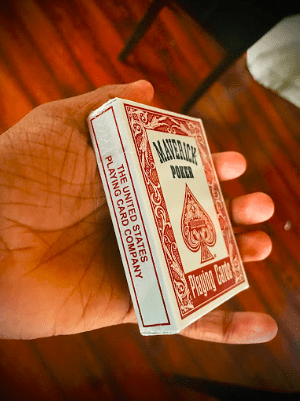
My dad and I often play games of cards such as “Go Fish”, and “Spoons”, but when we play he uses the common overhand shuffle. He insists that this is the best way to shuffle cards efficiently. However, me and my sister almost exclusively uses riffle shuffling , believing it is the most effective shuffling method. I wanted to scientifically test which of the most common shuffling methods is the most efficient. I would test this by taking a deck of cards in a certain configuration. Then, I mix them using various shuffling methods, to find which one performed the job the best. I would test 4 specific styles of shuffling. The first I would test is the previously mentioned, riffle shuffle. In this method half of the deck is held in each hand with the thumbs inward, then cards are released by the thumbs so that they fall to a surface interleaved. Next, I would test the piling method, in which the top card is placed into the first pile, and the second card in the second. This repeats until the fifth card, which is placed in the first pile, then the sixth card in the second pile and so on. Once the deck is done, stack the piles on top of each other from 1st to 4th. The next method I tested is called the overhand shuffle. This style involves, one gradually transferring the deck from your right hand to your left hand by sliding off small packets from the top of the deck with your thumb. The final style I tested is called the pool method. In this style cards are laid out on a surface and randomly placed into a pile to make a random deck. My methodology to determine whether the cards have moved might seem a little counter-intuitive. Rather than determining how much each individual card had moved in the deck, I grouped cards by suit and determined the amount of disturbance done to each group. The reason for this, in shuffling the goal isn’t to just move cards around, for that would mean that one cut would be the most efficient shuffling method (which it isn’t). Instead shuffling serves the purpose of breaking up groups or patterns in a deck, to provide the cards a sense of randomness. Therefore, we should judge the quality of a shuffling method based how well it breaks up groups.
Proof of Concept Test:
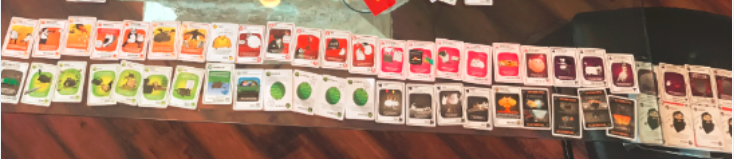
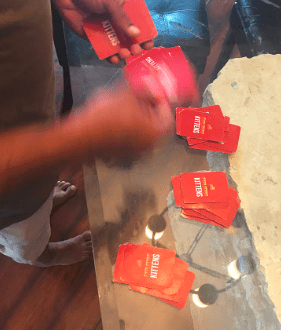
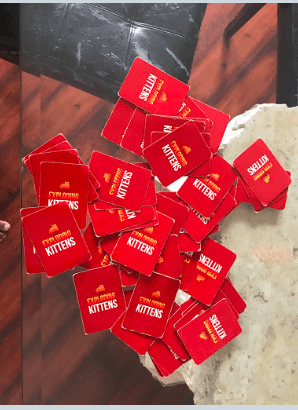
Before I began the experiment I wanted to ensure that my methodology was sound. For this reason I preformed a proof of concept test to see if my experiment would warrant statistical results. For this test, I needed a clear and obvious way to see results so I could easily view a big-picture look at how cards had moved. In order to do this, I used cards from a game (that I do not endorse) called, “Exploding Kittens”. The brightly colored cards, and similarly shaped cards of the game allowed me to easily make four 13-card groups divided by color, and to easily to see any results. Below is 52 cards from the game, “Exploding Kittens” before any shuffling takes place. It is a control to compare any shuffling done after. The first group of 13 cards, meant to be in place of diamonds in a normal deck are made up of red, orange and yellow cards. The next group of 13 cards, meant to be in place of clubs are made up of pink and purple cards. The following group of 13 cards meant to be in the place of hearts are made up of green cards. The final group of 13 cards meant to be in the place of spades are made up of grey, and black cards. With this in place it was time to shuffle and compare the results.




Results:
As for the riffle shuffle, the deck was affected in a significant way. The deck was spit into about 7 large clusters with each clusters having, on average 7 cards. The length of clusters was essentially, split, almost in half due to the riffle shuffle. Furthermore 86% of the cards moved to a new area of 13 cards after they were shuffled. The overhand shuffle, had 9 large clusters, with each cluster having an average of 4.5 cards. Finally, for the pool method there were no significant clumps. In all 52 cards statistically profound groupings of cards formed, and 78% of the cards moved to a new section of 13 cards. These results show that my methodology is solid, and with that information we can continue on to the real experiment. To see the shuffled results of each 4 styles click the link below
https://docs.google.com/document/d/1AZxddD8UBPO23YNTjCAUcbYCFDFvqkNd8CESRnAIE0o/edit?usp=sharing
Experiment:
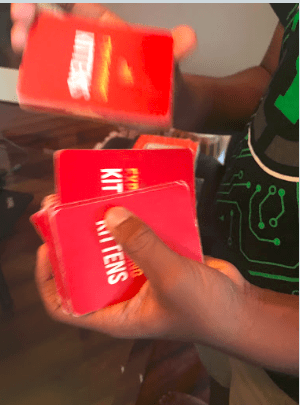
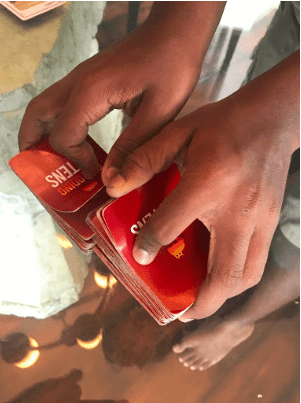
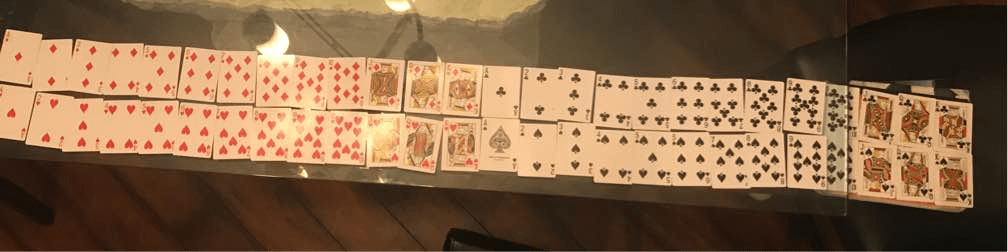
Now the difference between this experiment and the proof of concept test are two things. There are more trials, meaning coincidence is less of a variable, and each shuffle will be performed for the same amount of time (except the riffle which will be completed once). Both of these factors will make the test more reliable, and will yield more accurate results. I performed each shuffling style for 50 seconds each. I then recorded any clusters, the average size of those clusters, and how many cards left their suit area(13 card long section in which the suit was before it was shuffled). To see the results of each individual trial use the link below to see a spreadsheet that has just that. This will instead be an overall view of the trials, and what information I have gained from these trials. Let’s begin with the results for Overhand shuffle, the one my father uses. On average, each of my 5 trials had an average of about 5 clusters. This means 5 strings of 3 or more cards, in order. Furthermore, each of these of these clusters had an length of 4 cards. With a large amount, and size of clusters with this method, this style is undoubtedly not optimal. The next style I tested is the Riffle shuffle, the one my sister and I use. On average, this style resulted in 2 clusters with average lengths of 4 cards each. Due to the similar amounts and lengths of clusters, the riffle shuffle is not optimal, but because of the lessened amount of clusters, it is slightly better than the Overhand method. The following method I tested was the Piling method. This method had had 0 clusters throughout the experiment, but a pattern emerged. The same pattern of 3 or 4 spades followed by 3 or 4 hearts then, clubs, and diamonds recurred for each trial. This pattern makes the cards very predictable, which makes this shuffling style the worst out of the 4 I tested. The final style I tested was the Pool method. In this method, there were no clusters, and no pattern emerged. This makes the Pool method undoubtedly the best shuffling method, according to my experiment. This makes both my, and my dad’s hypothesis incorrect.
https://docs.google.com/spreadsheets/d/1nRcLKBBuwcCC7Li94gKX0lVJMlSIepGbzHOdA6ie1A4/edit?usp=sharing
Conclusion:
Since the 9th century card games have been a prevalent element in how humans occupy and entertain themselves. During difficult times in communities games like these have kept societies calm, collected, and unified, and most of all, have kept them happy. Hopefully, the knowledge I have acquired it makes that ancient tradition a little fairer and more fun for all who are involved. In the next post I will prepare the instruments required to perform experiments on bacterial growth.
 Proof that Parental Points Aren't Perfect