Does someone with a blindfold on, travel in circles?
Planning:
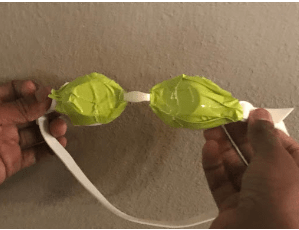
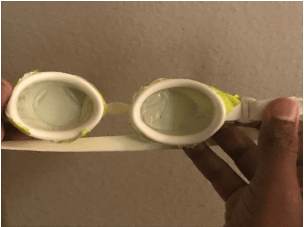
I wanted to test the comment that my mother made jokingly while I was washing the same dish over and over again trying to get the smudges off. “You’re doing that so badly it’s like you have a blindfold on. You’re going round and round in circles!” It was a joking remark, but it made me curious: if one were blindfolded would they resort to moving around and around in circles? My hypothesis is that you wouldn’t travel in circles if you were to travel blindfolded. I would test this experiment by having an open area with black-out goggles. These goggles would much more reliably block out the light than a blindfold that was tied around my face that could potentially fall off. In school I made a plan for 2 parts of the experiment. two part involved whether I would walk in circles, blindfolded, or swim circles. CPE is close to my house, which would provide me with a large open space to swim and to walk to test this experiment. My sister would walk behind me using the landmarks around us to tell if I had walked in full circles. She would do the same as I swam. For the walking section my sister would place objects behind me where I had walked to mark my path. We could review these for a more objective way to tell if I had truly walked in circles. In contrast, the limited space and the reality that my sister couldn’t place objects behind me made the swimming section of the experiment much more difficult, and objective according to my sister’s point of view. However, to combat this, all trials of this experiment would be recorded. This footage could be reviewed to paint a clearer picture.
Problems & Setbacks:
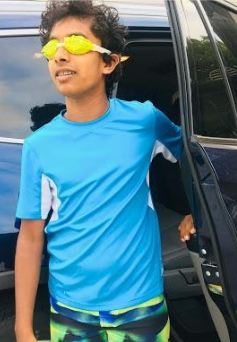
As you just read, I planned on wearing my blackout goggles to swim blind at CPE. However, this didn’t go exactly according to plan. As we walked in my parents and I became worrisome about keeping a phone so close to the water. We all decided the risk of dropping it while recording me was too high for the experiment. However, we thought that the experiment could still be accomplished. We believed that although the video was a vital objective part of the experiment, the experiment could still be accomplished within reason without it. As we arrived inside CPE, as my sister went off the the side, I prepared to enter on the perpendicular side. This side, happened to be right next to a lifeguard. The lifeguard took, what I only saw as a double-take, a moment of hesitation, and then a stern, yet confused question. “Did you put tape on your goggles?”. My sister, realizing the lifeguard’s imminent lecture and my inability to speak to anyone in authority, came to attempt to explain the situation. She told him about the project, the experiment and why I was wearing the blackout goggles. The lifeguard, slightly less confused, gave us a lecture on how dangerous it was, and how I could hit my head on the wall, or that if I went under, I needed to be able to see. He had a good point, and I’m glad, for my safety, that he said what he said, but me and my sister begrudgingly walked back to the car knowing that half of the experiment was now lost.
Procedure & Results:
Although the previously mentioned setbacks meant I couldn’t perform the aquatic portion of the test, we continued and later we performed the land portion of the test as described in the “Planning” section.
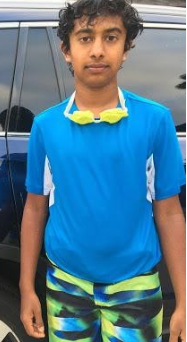
When we arrived at the park we were met with a fairly empty field. With a jacket, we marked the starting point that I would begin every trial at. I then used a compass and walked forward for 3 minutes north to provide a target for a perfectly straight walk. We then performed ten 3-minute trials. The reason we didn’t just keep walking until I bumped into something, was both for safety purposes and also as a way to keep each trial consistent. Therefore, every trial in which I bumped into something before the 3 minute mark had to be redone. In none of these trials I reached the completely straight goal. In 2 of these trials I merely drifted off of the imagined straight line, with a only a slightly curved path. In 4 of these trials I made a roughly 90 degree turn off of the target. 3 of these were to the right, and 1 was to the left, indicated no particular bias. Finally, in 4 out of 10 of the trials, I completed approximately a 180 degree turn, facing back in the direction I came. In all of these trials, before taking off my goggles, I believed to some extent that I had walked in a relatively straight line. I couldn’t differentiate between any of the significant deviations between the runs. In this case, according to the results of my experiment, my hypothesis was false, and my parents’ was true: Someone who is blindfolded does tend to walk in circles.

Conclusion:
The difference between blinded and non-blinded walking is fascinating. Small deviations from our mental model of the world, can add up into completely warped perceptions of reality. This experiment shows the incredible, yet fragile power of the human brain. We can learn to do things often thought impossible, yet that same brain can struggle with tasks as simple as walking, when not given enough information. Therefore, to equip our brains to be able to stand against its susceptibility, its egoism, and its fallacies, we must arm it with as much information is possible. Then, and only then can we traverse the complicated and often subjective reality more objectively. In the next post I will scientifically test the best shuffling method.
 Proof that Parental Points Aren't Perfect