Do batteries work better in colder environments?
The Plan:
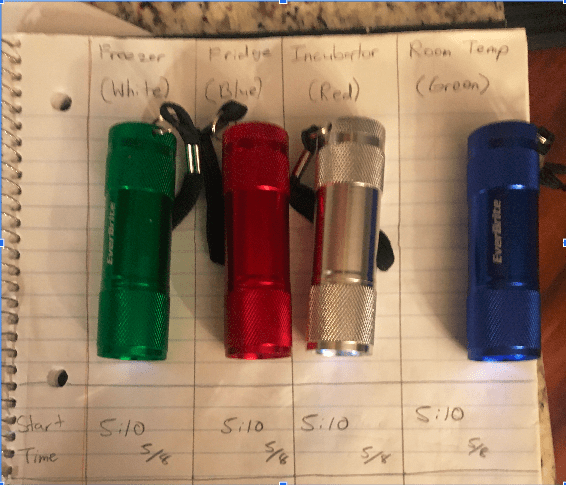
My family has a habit of keeping our batteries in cold environments, or at the least keeping them out of warm areas. Their reasoning for this is that the batteries will last longer in cold environments than in room temperature, and that batteries will work significantly worse in heated environments. However, I disagree. I predict that the he more extreme the temperature that batteries are kept at, the worse they will perform. Batteries kept at room temperature would work the best out of all. Overall, my hypothesis suggests that altering the temperature batteries are kept in will only hinder their performance. At school, I came up with a plan to test this, how I would implement it, how I would control the variables, and how I would the results would affect my hypothesis. I bought a set of 18 identical flashlights that came with identical batteries. I put the batteries in multiple conditions and temperatures, to see if any hinder or help the batteries’ performance. These conditions would be monitored and temperatures recorded over a defined time for all batteries. Then, these batteries would be put in a set of identical flashlights. The performance of each battery would be defined by how long the flashlights shined.
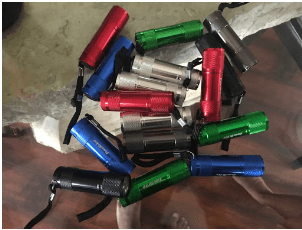
The Pre-Test:
I started with a test run, to make sure our methodology was correct. In this pre-test, we put room temperature batteries in a flashlight. I kept the batteries with me to make sure I knew the exact time it died. The flashlight stayed on for 44 hours. This information helps us address the first main problem. This was that I couldn’t reasonably watch the flashlights all day, and if I were to turn them off while I slept, that time could leave time for the batteries to cool down, jeopardizing the experiment. With the knowledge that the average flashlight would last for 44 hours, I could make sure I spent time watching the flashlights in the correct times. Furthermore, by watching an identical flashlight burn out, I knew what a flashlight that was about to give out looked like. The reason I didn’t use the tactic I had just used of keeping it with me, is because carrying it with me resulted in the flashlights being rolled, and bumped around. In some cases this could make a flashlight that could go for a few more hours, suddenly fizzle out. With this knowledge, I could proceed to the experiment. I placed batteries in the fridge, the freezer,(which both have a temperature display), and an area of my house near the house thermostat. To achieve the heated temperatures I brought back my old friend the incubator. The knowledge I have gained in the past (see 5 sec. Spaghetti Spoil & Testing Tainted Tables) can easily translate to recording the temperature of heating batteries.
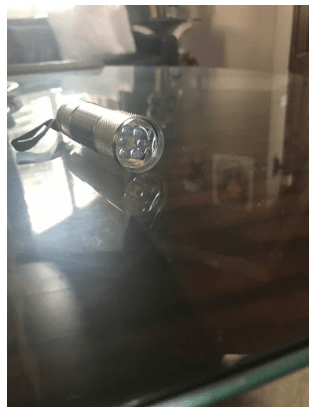
The Experiment:
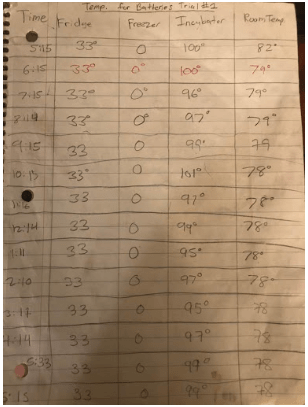
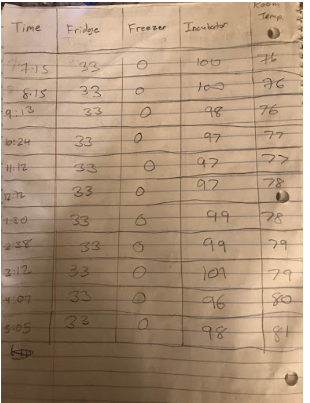
I tested batteries in room temperature, heated temperatures, temperatures just above freezing, and below freezing temperatures. From the moment the batteries were placed in their respective environments, I would check and record the temperatures for each environment for 24 hours. The average temperature for the room, heated, above freezing, and freezing temperatures are respectively, 81.5 degrees, 102.2 degrees, 33 degrees, and 0 degrees. After 24 hours had passed the next phase was implemented in which the batteries were placed in identical flashlights. Again the temperature that the flashlights were in was recorded. My family and I worked together (since some of my family members had to wake up earlier, and others chose to stay up late) to mark the temperature each hour, and to check if the flashlights were still on, if possible).
The Results:
The flashlights lasted an astounding 3 and a half weeks! The first of the flashlights to die was the incubator battery. As anyone who has taken their phone out in a hot day in California, heat can extensively degrade a battery, and that was reflected in the results of my experiment. As for the other three, all of the rest died within a few hours of each other, which is not a significant difference. Due to this negligible time frame, it can be said that batteries in room temperature, fridge temp., and freezing conditions all have roughly the same effectiveness at keeping batteries alive. In this case, according to the results of my experiment, both my parents’ and my hypotheses were partially correct: Batteries work best in room, fridge, and sub-zero temperature, while heat can corrode them.
Conclusion:
For those wondering, the reason the batteries in the experiment lasted so much longer than the Pre-Test is for the exact reason I mentioned in the “Pre-Test” section. “The reason I didn’t use the tactic I had just used of keeping it with me, is because carrying it with me resulted in the flashlights being rolled, and bumped around. In some cases this could make a flashlight that could go for a few more hours, suddenly fizzle out”. I thought this difference was profound enough to not have it repeated in my experiment, while being negligible enough that it could be used as a reliable Pre-Test. However, this does not detract from the things we can learn from this experiment. In fact we can learn even more about flashlights. As we have seen, and as I have learned movement, hard falls, being jostled out of place, and flashlights hitting surfaces are the worst thing to happen to batteries. So the real way to keep batteries alive longer? Keep them at whatever temperature you want, other than extreme heat, and just don’t mess around with them. Use them when you need them, and put them in a place or rest when you don’t, and your batteries will live long happy lives. Next month I am planning on testing the statement my parents often make when meeting relatives with children. They say, “Oh you look just like your child”. I am doing an experiment to test this.

 Proof that Parental Points Aren't Perfect